-
Templates
1099 FormsAccurately report 1099 information returns and ensure IRS filing with easeExplore all templatesW-9 W-8 FormsEasily manage and share taxpayer details to streamline payments and meet IRS requirements with confidenceExplore all templatesOther Tax FormsFillable tax forms simplify and speed up your tax filing process and aid with recordkeeping.Explore all templatesReal EstateReal estate templates for all cases, from sale to rentals, save you a lot of time and effort.Explore all templatesLogisticsSimplify your trucking and logistics paperwork with our ready-to-use transportation and freight templates.Explore all templatesMedicalMedical forms help you keep patient documentation organized and secure.Explore all templatesBill of SaleBill of Sale templates streamline the transfer of ownership with clarity and protection.Explore all templatesContractsVarious contract templates ensure efficient and clear legal transactions.Explore all templatesEducationEducational forms and templates enhance the learning experience and student management.Explore all templates
-
Features
FeaturesAI-Enhanced Document Solutions for Contractor-Client Success and IRS ComplianceExplore all featuresAI Summarizer Check out the featureAI PDF summarizer makes your document workflow even faster. Ask AI to summarize PDF, assist you with tax forms, complete assignments, and more using just one tool.Sign PDF Check out the featurePDFLiner gives the opportunity to sign documents online, save them, send at once by email or print. Register now, upload your document and e-sign it onlineFill Out PDF Check out the featurePDFLiner provides different tools for filling in PDF forms. All you need is to register, upload the necessary document and start filling it out.Draw on a PDF Check out the featureDraw lines, circles, and other drawings on PDF using tools of PDFLiner online. Streamline your document editing process, speeding up your productivity
- Solutions
- Features
- Blog
- Support
- Pricing
- Log in
- Sign Up


Form W-4 (2026)
What is Form W-4?
Form W-4, Employee's Withholding Certificate, tells your employer how much federal income tax to withhold from your pay. If too little is withheld, you will generally owe tax when you file your return and may owe a penalty; if too much is withheld, you will generally get a refund. You give the completed form to your employer; you don't send it to the IRS. The form above is the 2026 revision, five pages: the certificate is page 1, followed by instructions, two worksheets marked "Keep for your records" and the multiple-jobs tables.
Who fills out Form W-4, and when
- Starting a job. An employer asks every new employee for a signed Form W-4. If you don't give one, the employer withholds as if you had checked single or married filing separately and made no other entries.
- When your entries would change. Complete a new Form W-4 when a change in your personal or financial situation would change what you enter. The IRS suggests considering a new form each year.
- Within 10 days in some cases. If one of the changes listed in Publication 505 happens (for example, your filing status changes from married filing jointly to head of household or single, or you no longer expect to be able to claim a child tax credit you counted on your Form W-4) and you won't have enough tax withheld for the rest of 2026, you must give your employer a new Form W-4 within 10 days of the change. If your filing status changes during 2026 from married filing jointly (or qualifying surviving spouse) to head of household or single (or married filing separately), or from head of household to single (or married filing separately), but you will still have enough tax withheld for 2026, you must give your employer a new Form W-4 for 2027 by December 1, 2026, or 10 days after the change if that is later.
- A form on file stays in effect. A Form W-4 for 2025 or an earlier year remains in effect for 2026 unless you give your employer a 2026 form. Two exceptions: an exemption claim lasts one calendar year (below), and once an IRS lock-in letter takes effect, the employer withholds as the letter specifies and disregards a Form W-4 that would result in less tax withheld; a Form W-4 that results in more tax withheld than the letter is still honored.
- More than one job. Give a separate Form W-4 for each job.
If you are a nonresident alien, see IRS Notice 1392 before completing the form.
How to fill out Form W-4
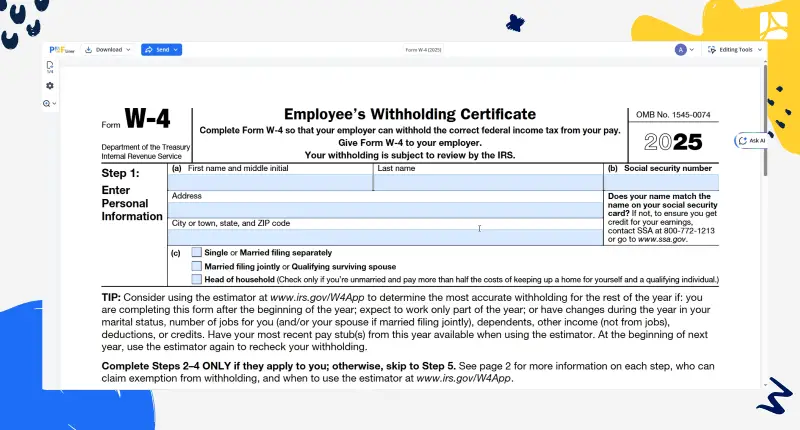
Complete Steps 1(a), 1(b) and 5. If you are not claiming exemption, also complete Step 1(c), and Steps 2, 3 and 4 only if they apply to you. If you claim exemption, check the "Exempt from withholding" box and complete only Steps 1(a), 1(b) and 5.
- Step 1, personal information: (a) your name and address, (b) your social security number, and (c) your expected filing status: single or married filing separately; married filing jointly or qualifying surviving spouse; or head of household (only if you're unmarried and pay more than half the costs of keeping up a home for yourself and a qualifying individual). The filing status sets the standard deduction and tax rates used for your withholding.
- Step 2, multiple jobs or spouse works: complete it if you hold more than one job at a time, or are married filing jointly and your spouse also works. Do only one of three things: (a) use the IRS estimator at www.irs.gov/W4App (the option to use if you or your spouse have self-employment income); (b) use the Multiple Jobs Worksheet on page 3 and enter the result in Step 4(c); or (c) if there are only two jobs in total, check the box, and do the same on the Form W-4 for the other job. Option (c) is accurate for jobs with similar pay (the form says it is generally more accurate than (b) if pay at the lower paying job is more than half of the pay at the higher paying job); otherwise more tax than necessary may be withheld. Complete Steps 3 to 4(b) on the Form W-4 for only one of the jobs; withholding is most accurate if that is the highest paying job.
- Step 3, dependent and other credits: if your total income will be $200,000 or less ($400,000 or less if married filing jointly), multiply the number of qualifying children under age 17 by $2,200 (line 3(a)) and the number of other dependents by $500 (line 3(b)), then add the amount for other credits. These are the amounts printed on the 2026 form; the Step 3 instructions on page 2 say who counts.
- Step 4, other adjustments: 4(a) is for other income not from jobs that won't have withholding, such as interest, dividends and retirement income (don't include income from any job or from self-employment); 4(b) is the result of the Deductions Worksheet on page 4, line 15, if you expect deductions other than the basic standard deduction (if you skip it, withholding is based on the standard deduction); 4(c) is any extra tax you want withheld each pay period, including the amount from the Multiple Jobs Worksheet.
- Step 5, sign and date. The form is not valid unless you sign it.
The "Employers Only" block at the bottom (employer's name and address, first date of employment, EIN) is filled in by your employer; the form has no employer signature line. Enter only what the form, its instructions or other IRS guidance requests or permits: any unauthorized change or addition makes a Form W-4 invalid. Withholding allowances are no longer used on the form.
The form's own tip: consider the IRS estimator at www.irs.gov/W4App if you are completing the form after the beginning of the year, expect to work only part of the year, or have changes during the year in marital status, jobs, dependents, other income, deductions or credits.
The 2026 Deductions Worksheet (Step 4(b))
The worksheet on page 4 feeds Step 4(b). On the 2026 form it lets you estimate, within the income limits printed on it:
- qualified tips: up to $25,000, if your total income is less than $150,000 ($300,000 if married filing jointly);
- qualified overtime compensation: up to $12,500 ($25,000 if married filing jointly) of the "and-a-half" portion of time-and-a-half pay, with the same income limits;
- qualified passenger vehicle loan interest: up to $10,000, if your total income is less than $100,000 ($200,000 if married filing jointly);
- seniors age 65 or older before the end of the year: $6,000 for you and $6,000 for your spouse (the spouse line also requires a social security number valid for employment), if your total income is less than $75,000 ($150,000 if married filing jointly).
These are the worksheet's figures for estimating 2026 withholding. Whether you qualify for a deduction on your tax return is explained in the Instructions for Schedule 1-A (Form 1040), to which the worksheet refers.
Claiming exemption from withholding for 2026
You may claim exemption only if both are true: you had no federal income tax liability in 2025, and you expect to have none in 2026. You had no liability in 2025 if your total tax on line 24 of your 2025 Form 1040 or 1040-SR is zero (or less than the sum of lines 27a, 28, 29 and 30), or if you were not required to file a return because your income was below the filing threshold for your filing status.
To claim it, check the box in the "Exempt from withholding" section and complete Steps 1(a), 1(b) and 5 only. No income tax will be withheld from your pay, and you may owe taxes and penalties when you file your 2026 return. Social security and Medicare taxes still apply to your wages.
The claim is good for one calendar year. To stay exempt you need to give your employer a new Form W-4 by February 16, 2027; otherwise the employer withholds as if you had checked single or married filing separately with no other entries. If your situation changes so that you will owe income tax after all, give a new Form W-4 within 10 days; if you claim exemption for 2026 but expect to owe income tax for 2027, give a new form for 2027 by December 1, 2026, or within 10 days after the change that creates that expectation, whichever is later.
Signing Form W-4 and giving it to your employer
Step 5 is your signature and date, under penalties of perjury; the form is not valid without it. Give the signed form to your employer.
An employer may set up a system to receive Forms W-4 electronically. Treasury regulations require such a system to make it reasonably certain that the person submitting the form is the employee named on it, and require the employee's electronic signature, made under penalties of perjury, as the final entry. Whether an electronically signed Form W-4 is accepted therefore depends on your employer: ask before you sign electronically, and otherwise print the form and sign it by hand.
For employers
- Ask every new employee for a signed Form W-4 when they start work and make it effective with the first wage payment.
- Put a replacement Form W-4 into effect no later than the start of the first payroll period ending on or after the 30th day after you receive it. A Form W-4 that makes a change for the next calendar year doesn't take effect in the current calendar year. Exceptions apply to exemption claims, IRS lock-in letters and invalid forms.
- Don't use an invalid Form W-4. Tell the employee it is invalid and ask for another one; if you don't get a valid one, withhold as single or married filing separately with no other entries, or as before if you have an earlier valid Form W-4 for that employee.
- Keep each Form W-4 in your records for at least 4 years. You may be directed to send certain Forms W-4 to the IRS, and you must be able to supply a hard copy of an electronic Form W-4.
- Employees who gave you a Form W-4 before 2020 are not required to give a new one merely because the form was redesigned; an employee who wants to adjust withholding must use the redesigned form.
What changed on the 2026 Form W-4
Compared with the 2025 form:
- Exemption is claimed by checking a new "Exempt from withholding" box; on the 2025 form you wrote "Exempt" in the space below Step 4(c).
- Step 3 now has lines 3(a) and 3(b), and the amount per qualifying child under age 17 is $2,200 (2025: $2,000).
- The Deductions Worksheet has its own page, and its result now comes from line 15, with new lines for qualified tips, overtime compensation, passenger vehicle loan interest and seniors.
- Page 1 adds a caution that certain credits and deductions require a social security number valid for employment.
- The form has five pages instead of four.
Earlier forms are under "Show form versions" for reference.
Form W-4 resources
- Form W-4 (2026), IRS PDF
- About Form W-4, IRS.gov
- Tax Withholding Estimator, IRS.gov
- Topic no. 753, Form W-4, IRS.gov
- Publication 505 (2026), Tax Withholding and Estimated Tax
- FAQs on the Form W-4, IRS.gov
- Formulario W-4 (SP), the Spanish form
- Form W-2
Form Versions
2025
Fillable Form W-4 for 2025
2024
Fillable Form W-4 for 2024
2021
Fillable Form W-4 (2021)
Form W-4: frequently asked questions
-
Do I send Form W-4 to the IRS?
No. You give Form W-4 to your employer. The employer keeps it in its records for at least 4 years and may be directed to send certain Forms W-4 to the IRS; the form itself says your withholding is subject to review by the IRS.
-
Do I have to complete every step of Form W-4?
No. Complete Steps 1(a), 1(b) and 5. If you are not claiming exemption, also complete Step 1(c), and Steps 2, 3 and 4 only if they apply to you. If you claim exemption, check the "Exempt from withholding" box and complete only Steps 1(a), 1(b) and 5.
-
Do I need to give my employer a new Form W-4 every year?
Generally no. A Form W-4 for 2025 or an earlier year remains in effect for 2026 unless you give your employer a 2026 form (or an IRS lock-in letter is in effect), although the IRS suggests considering a new form each year. Three cases differ: an exemption claim lasts one calendar year (a new form is due by February 16, 2027 to keep it); you must give a new form within 10 days if one of the changes listed in Publication 505 happens and too little tax would be withheld for the rest of the year; and you complete a new form whenever a change would alter your entries.
-
Can I sign Form W-4 electronically?
The form must be signed to be valid. An employer may set up a system to receive Forms W-4 electronically, and Treasury regulations then require your electronic signature, under penalties of perjury, as the final entry. So it depends on your employer: if they accept Forms W-4 electronically, follow their process; if not, print the form and sign it by hand.
-
Who can claim exemption from withholding for 2026?
Only an employee who had no federal income tax liability in 2025 and expects none in 2026. You check the "Exempt from withholding" box and complete Steps 1(a), 1(b) and 5 only. No income tax is withheld from your pay, and you may owe taxes and penalties when you file your 2026 return. The claim lasts for 2026 only; a new Form W-4 is needed by February 16, 2027 to keep it.
-
Is there a penalty for a wrong Form W-4?
You may have to pay a $500 penalty if you make statements on Form W-4 that reduce the tax withheld and you have no reasonable basis for them when you prepare the form. There is also a criminal penalty for willfully supplying false or fraudulent information on Form W-4, or for willfully failing to supply information that would increase the amount withheld.
Related Content - Form W-4 (2026)
-
![]() Form 1099-GWhat Is a 1099 G Form? If you are looking for what is a 1099-G...
Form 1099-GWhat Is a 1099 G Form? If you are looking for what is a 1099-G... -
![]() Form 1098What is IRS Form 1098 Mortgage Interest? This document is filled out by lenders and...
Form 1098What is IRS Form 1098 Mortgage Interest? This document is filled out by lenders and... -
![]() Form W-7What is a W7 Form? Form W-7 is an application for IRS individual taxpayer identification...
Form W-7What is a W7 Form? Form W-7 is an application for IRS individual taxpayer identification... -
![]() Form W-2ASWhat Is Form W-2AS Form W-2AS is essentially the American Samoa equivalent of the standard...
Form W-2ASWhat Is Form W-2AS Form W-2AS is essentially the American Samoa equivalent of the standard... -
![]() W-2 Form 2026How to fill out Form W-2 for 2026 Form W-2, Wage and Tax Statement, reports...
W-2 Form 2026How to fill out Form W-2 for 2026 Form W-2, Wage and Tax Statement, reports...





Fillable online Form W-4 (2026)