-
Templates
1099 FormsAccurately report 1099 information returns and ensure IRS filing with easeExplore all templatesW-9 W-8 FormsEasily manage and share taxpayer details to streamline payments and meet IRS requirements with confidenceExplore all templatesOther Tax FormsFillable tax forms simplify and speed up your tax filing process and aid with recordkeeping.Explore all templatesReal EstateReal estate templates for all cases, from sale to rentals, save you a lot of time and effort.Explore all templatesLogisticsSimplify your trucking and logistics paperwork with our ready-to-use transportation and freight templates.Explore all templatesMedicalMedical forms help you keep patient documentation organized and secure.Explore all templatesBill of SaleBill of Sale templates streamline the transfer of ownership with clarity and protection.Explore all templatesContractsVarious contract templates ensure efficient and clear legal transactions.Explore all templatesEducationEducational forms and templates enhance the learning experience and student management.Explore all templates
-
Features
FeaturesAI-Enhanced Document Solutions for Contractor-Client Success and IRS ComplianceExplore all featuresAI Summarizer Check out the featureAI PDF summarizer makes your document workflow even faster. Ask AI to summarize PDF, assist you with tax forms, complete assignments, and more using just one tool.Sign PDF Check out the featurePDFLiner gives the opportunity to sign documents online, save them, send at once by email or print. Register now, upload your document and e-sign it onlineFill Out PDF Check out the featurePDFLiner provides different tools for filling in PDF forms. All you need is to register, upload the necessary document and start filling it out.Draw on a PDF Check out the featureDraw lines, circles, and other drawings on PDF using tools of PDFLiner online. Streamline your document editing process, speeding up your productivity
- Solutions
- Features
- Blog
- Support
- Pricing
- Log in
- Sign Up


Form 940, Employer's Annual Federal Unemployment (FUTA) Tax Return
What is Form 940?
Form 940, Employer's Annual Federal Unemployment (FUTA) Tax Return, is an Internal Revenue Service form. Employers use it to report their annual Federal Unemployment Tax Act (FUTA) tax. The IRS instructions explain that the FUTA tax, together with state unemployment tax systems, provides funds for paying unemployment compensation to workers who have lost their jobs. Only employers pay FUTA tax: it is not collected or deducted from employees' wages.
The blank on this page is Form 940 for 2025.
Who files Form 940?
The Instructions for Form 940 give two questions about the wages an employer paid and the employees it had. With the exceptions the instructions list, an employer who answers "Yes" to either question must file Form 940. Employers of household employees generally file Schedule H (Form 1040) instead. Services rendered by employees of a state, or of a political subdivision or instrumentality of a state, are exempt from FUTA tax, and no Form 940 is required for them.
What is on the form?
The return has two pages. At the top the employer enters its employer identification number, name and address. Under "Type of Return" the form says "Check all that apply": the boxes are for an amended return, a successor employer, no payments to employees in the year, and a final return. Seven parts follow:
- Part 1: Tell us about your return.
- Part 2: Determine your FUTA tax before adjustments.
- Part 3: Determine your adjustments.
- Part 4: Determine your FUTA tax and balance due or overpayment.
- Part 5: Report your FUTA tax liability by quarter. The form says when this part is completed.
- Part 6: May we speak with your third-party designee?
- Part 7: Sign here. It ends with the section "Paid Preparer Use Only".
The form sends two groups of employers to Schedule A (Form 940): an employer that had to pay state unemployment tax in more than one state (line 1b), and an employer that "paid wages in a state that is subject to credit reduction" (line 2). The third page of the file is Form 940-V, Payment Voucher, which is completed when the balance due on Form 940 is paid by check or money order. The voucher is not used for federal tax deposits, and the instructions say when FUTA tax must be deposited rather than paid with the return.
Signing and filing
The form says: "You MUST complete both pages of this form and SIGN it." The instructions name who signs for each kind of employer, for example the individual who owns the business for a sole proprietorship, and say when a paid preparer must also sign. The IRS encourages employers to file Form 940 electronically. For a paper return, the instructions give the mailing addresses by the employer's location and by whether a payment is included, with separate rules for some filers, such as amended returns. The instructions add a caution: "Your filing address may have changed from that used to file your employment tax return in prior years."
Form Versions
2022
Fillable Form 940 for 2022
2021
Fillable Form 940 for 2021
2020
Fillable Form 940 for 2020
2023
Fillable Form 940 for 2023
FAQ: IRS Form 940 Popular Questions
-
Where to file 940 form?
Mailing addresses for form 940 are available at the official IRS website.
-
What is the difference between 940 and 941?
Form 940 is an annual return on which an employer reports federal unemployment (FUTA) tax. Form 941 is the Employer's QUARTERLY Federal Tax Return: on it an employer reports the federal income tax, social security tax and Medicare tax withheld from employees' pay, and the employer's own share of social security and Medicare tax.
Related Content - Form 940
-
![]() Form 941What Is 941 Form? 941 fillable form is submitted by employers to report the taxes...
-
![]() Form 941-XWhat Is Form 941 X? Want to know the basics about this form? We’ve got...
-
![]() Form 941 (March 2021)Can I still fill out Form 941 for 2021? A Form 941 is a tax form...
-
![]() Form 945What do I need the IRS Form 945 for? What is Form 945 used for?...
-
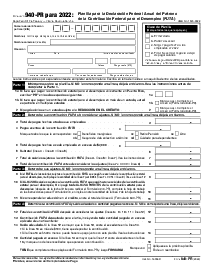
![]() Form 940 PRForm 940-PR was the Puerto Rico version of the Employer's Annual Federal Unemployment (FUTA) Tax...


Fillable online Form 940