-
Templates
1099 FormsAccurately report 1099 information returns and ensure IRS filing with easeExplore all templatesW-9 W-8 FormsEasily manage and share taxpayer details to streamline payments and meet IRS requirements with confidenceExplore all templatesOther Tax FormsFillable tax forms simplify and speed up your tax filing process and aid with recordkeeping.Explore all templatesReal EstateReal estate templates for all cases, from sale to rentals, save you a lot of time and effort.Explore all templatesLogisticsSimplify your trucking and logistics paperwork with our ready-to-use transportation and freight templates.Explore all templatesMedicalMedical forms help you keep patient documentation organized and secure.Explore all templatesBill of SaleBill of Sale templates streamline the transfer of ownership with clarity and protection.Explore all templatesContractsVarious contract templates ensure efficient and clear legal transactions.Explore all templatesEducationEducational forms and templates enhance the learning experience and student management.Explore all templates
-
Features
FeaturesAI-Enhanced Document Solutions for Contractor-Client Success and IRS ComplianceExplore all featuresAI Summarizer Check out the featureAI PDF summarizer makes your document workflow even faster. Ask AI to summarize PDF, assist you with tax forms, complete assignments, and more using just one tool.Sign PDF Check out the featurePDFLiner gives the opportunity to sign documents online, save them, send at once by email or print. Register now, upload your document and e-sign it onlineFill Out PDF Check out the featurePDFLiner provides different tools for filling in PDF forms. All you need is to register, upload the necessary document and start filling it out.Draw on a PDF Check out the featureDraw lines, circles, and other drawings on PDF using tools of PDFLiner online. Streamline your document editing process, speeding up your productivity
- Solutions
- Features
- Blog
- Support
- Pricing
- Log in
- Sign Up


Form 2555 (2025)
What is Form 2555?
Form 2555, Foreign Earned Income, is the form U.S. citizens and resident aliens use to figure the foreign earned income exclusion and the housing exclusion or deduction. You cannot exclude or deduct more than your foreign earned income for the year. Form 2555 is attached to Form 1040 or 1040-SR; it is not filed on its own and has no signature line. The form above is the 2025 revision, three pages. For tax year 2025 the maximum exclusion is $130,000 per qualifying person, prorated if you qualify for only part of the year; for tax years beginning in 2026 it is $132,900.
Who can use Form 2555
You may qualify if both of these apply:
- Tax home test. Your tax home (your regular or principal place of business, employment or post of duty, wherever your family lives) is in a foreign country throughout your period of bona fide residence or physical presence. You don't have a foreign tax home for any period in which your abode is in the United States, unless you serve in support of the U.S. Armed Forces in a designated combat zone.
- Bona fide residence test or physical presence test. Bona fide residence: you are a U.S. citizen (or a U.S. resident alien who is a citizen or national of a country that has an income tax treaty with the United States) and a bona fide resident of a foreign country or countries for an uninterrupted period that includes an entire tax year. Physical presence: you are a U.S. citizen or resident alien physically present in a foreign country or countries for at least 330 full days during any 12 months in a row; a full day is the 24 hours starting at midnight.
A "foreign country" doesn't include U.S. territories or the Antarctic region, and it doesn't include international waters or the airspace above them.
Limits and exceptions:
- Pay for working abroad as an employee of the U.S. Government doesn't qualify for the exclusions or the housing deduction; don't file Form 2555 for it.
- If you told the foreign country's authorities that you aren't a resident there and you aren't required to pay its income tax (line 13a "Yes" and line 13b "No"), you don't qualify as a bona fide resident.
- If you were in Cuba in violation of U.S. travel restrictions, the time you spent there doesn't count toward either test and income earned there isn't foreign earned income. Housing expenses in Cuba, and housing expenses for your spouse or dependents in another country while you were in Cuba, aren't qualified housing expenses. Performing services at the U.S. Naval Base at Guantanamo Bay is not a violation of those restrictions.
- The minimum time requirements may be waived if you had to leave a country because of war, civil unrest or similar adverse conditions. You must be able to show that you could reasonably have expected to meet them if you hadn't been required to leave. The IRS publishes each year the only countries and dates that qualify (for 2025, Revenue Procedure 2026-16). You must have established residence or been physically present in the country on or before the date listed for it, and have left on or after that date; you then claim the benefits only for the days you were actually resident or present, attach a statement, and enter "Claiming Waiver" in the top margin of page 1.
The 2025 amounts and how they are prorated
- Maximum exclusion. $130,000 for tax year 2025 (line 37). If your qualifying period covers only part of 2025, the maximum is multiplied by the number of qualifying days that fall in your 2025 tax year divided by the days in the year (lines 38 to 40). The IRS example: a tax home and bona fide residence established on August 14, 2025 and maintained until January 31, 2027 gives 140 qualifying days in 2025 (August 14 through December 31). The exclusion is the smaller of that figure and your foreign earned income left after any housing exclusion (lines 41 and 42).
- Two different day counts. The 330 full days belong to the physical presence test and are counted over a 12-month period, which may begin or end outside 2025. The days used to prorate the exclusion are the days of your qualifying period that fall inside the tax year. Your qualifying period is the period in which you meet the tax home test and one of the two tests.
- Foreign earned income. Wages, salaries, professional fees and other pay for personal services you performed in a foreign country while you met the tests. It doesn't include, among other items, pensions and annuities (including social security benefits), interest, dividends, capital gains or alimony, pay from the U.S. Government to its employees, or amounts received after the end of the tax year following the year you did the work.
- Housing. The base housing amount is $56.99 a day ($20,800 for a full year, line 32). For 2025 the limit on housing expenses is $39,000 for most locations if your qualifying period covers all of 2025 ($106.85 a day otherwise); locations listed in IRS Notice 2025-16 have their own limits, and where the 2026 limit for a location in Notice 2026-25 is higher, you may apply that limit to 2025 instead. The housing exclusion (Part VI) is figured from employer-provided amounts. If all of your foreign earned income is self-employment income, you skip lines 34 and 35, enter zero on line 36 and, if you qualify, use the housing deduction in Part IX.
- Married couples. If both spouses qualify and choose the exclusion, each figures it separately and completes Part VII of their own Form 2555.
How to fill out Form 2555
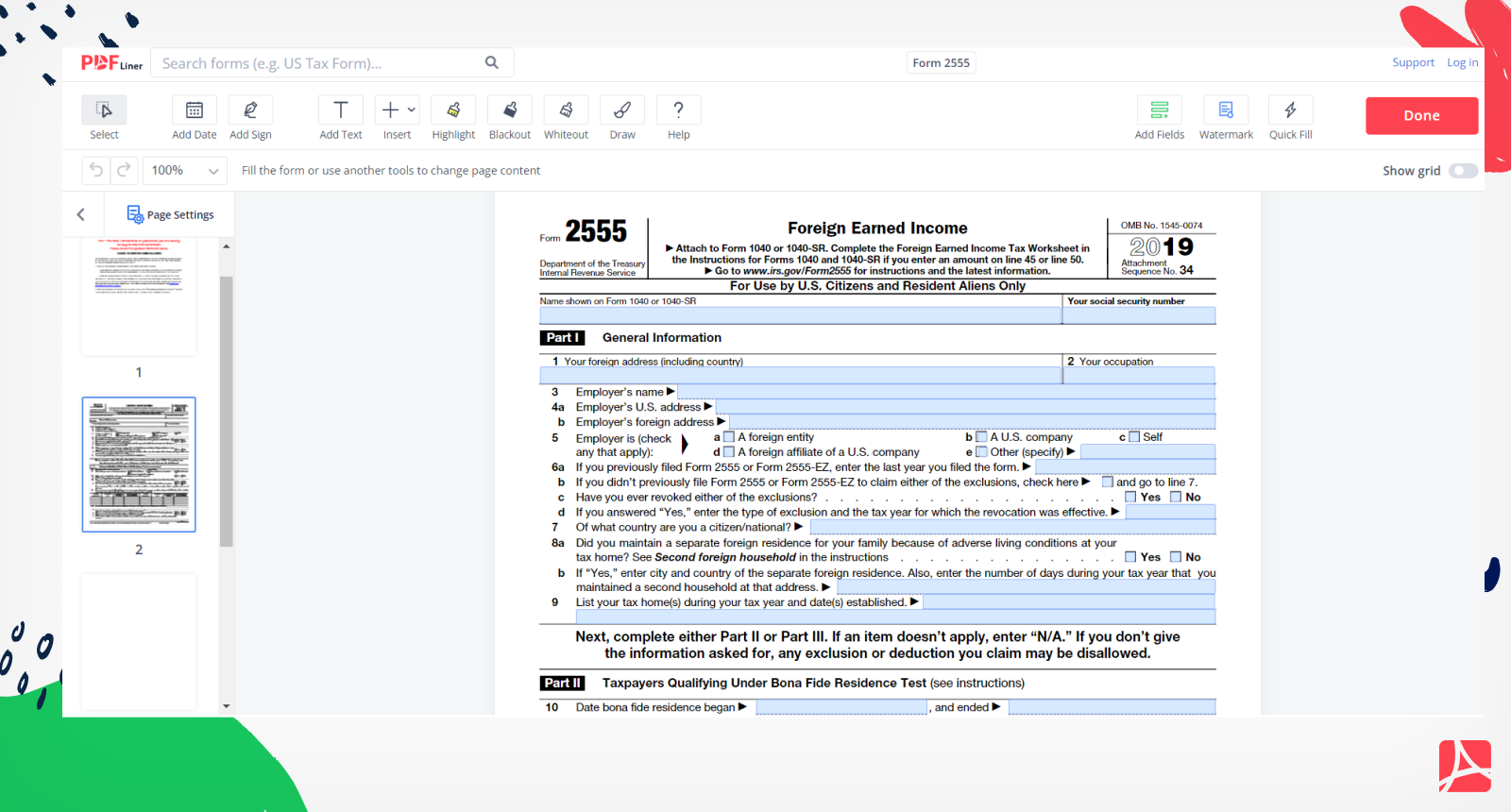
The 2025 form has three pages and nine parts:
- Part I, General Information (lines 1-9): your foreign address, occupation, employer, earlier Forms 2555, citizenship and tax home(s).
- Part II or Part III, not both. Part II (lines 10-15) is for the bona fide residence test; Part III (lines 16-18) is for the physical presence test, with the 12-month period and your travel. If an item doesn't apply, enter "N/A": if you don't give the information asked for, the exclusion or deduction may be disallowed.
- Part IV (lines 19-26): your 2025 foreign earned income in U.S. dollars.
- Part V (line 27) and Part VI (lines 28-36): the housing question, your qualified housing expenses, the limit, the base housing amount and the housing exclusion.
- Part VII (lines 37-42): the foreign earned income exclusion.
- Part VIII (lines 43-45): the total of your exclusions less the deductions allocable to the excluded income. Line 45 goes on Schedule 1 (Form 1040), line 8d.
- Part IX (lines 46-50): the housing deduction, completed only if line 33 is more than line 36 and line 27 is more than line 43. Line 50 goes on Schedule 1 (Form 1040), line 24j.
If you enter an amount on line 45 or line 50, complete the Foreign Earned Income Tax Worksheet in the Instructions for Form 1040: the tax on the income you don't exclude is figured at the rates that would have applied without the exclusion.
There is no carryover of an unused foreign earned income exclusion. Only the housing deduction carries over, and only for one year: an excess from 2025 can be used in 2026, and if it can't be deducted then, it is lost.
Filing Form 2555
- With your return. Attach Form 2555 to Form 1040 or 1040-SR. A paper return with Form 2555 goes to one of the special IRS addresses for those filing Form 2555, not to the address for your state.
- Dates for a 2025 calendar-year return. The return was generally due April 15, 2026. If on the due date you lived outside the United States and Puerto Rico and your tax home was outside them too, you had an automatic 2-month extension to June 15, 2026, with a statement attached to the return explaining that you met both conditions. The extension also covers payment, but interest runs from the regular due date on any tax not paid by then.
- Not yet qualified by the due date. In the first year, you can apply on Form 2350, before the due date of your return, for a special extension to a date after you expect to qualify, or file on time without the exclusion and amend the return once you qualify.
- Choosing and revoking. Your first choice of an exclusion must usually be made on a timely filed return (including extensions) or on a later return that amends a timely filed return and is filed within the period for claiming a refund (Internal Revenue Code section 6511(a)); there are exceptions, for example a late return filed within 1 year from its original due date (see the IRS page "Choosing the foreign earned income exclusion"). The choice stays in effect for later years until you revoke it by a statement attached to your return. Taking a foreign tax credit or deduction for tax on income you could have excluded, the additional child tax credit or the earned income credit in a later year is also treated as a revocation. After a revocation you can't claim the exclusion for your next 5 tax years without IRS approval.
- Earlier years. The amounts printed on the form are specific to each tax year; the 2023 and 2024 forms are under "Show form versions".
What claiming the exclusion changes
- You can't take the earned income credit or the additional child tax credit if you claim either exclusion or the housing deduction.
- You can't take a credit or deduction for foreign income taxes on income you exclude; if you exclude only part of your income, the foreign taxes allocable to the excluded part are not creditable or deductible.
- Self-employment tax is not reduced: all of your self-employment income counts toward net earnings from self-employment, even income excluded from income tax by the foreign earned income exclusion. Separately, a social security (totalization) agreement between the United States and the country where you live may mean you are covered only by that country's system; see Publication 54.
- You may still have to file: when you check whether you must file a return, your gross income includes the income you can exclude.
Form 2555 resources
- Form 2555 (2025), IRS PDF
- 2025 Instructions for Form 2555, IRS PDF
- About Form 2555, IRS.gov
- Publication 54, Tax Guide for U.S. Citizens and Resident Aliens Abroad
- Foreign earned income exclusion, IRS.gov
- Choosing the foreign earned income exclusion, IRS.gov
- International: where to file Form 1040, IRS.gov
- About Form 2350, IRS.gov
- Foreign Earned Income Tax Worksheet
- Schedule 1 (Form 1040)
Form Versions
2024
Fillable Form 2555 for 2024
2023
Fillable Form 2555 for 2023
2022
Fillable Form 2555 for 2022
Form 2555: frequently asked questions
-
Do I file Form 2555 by itself?
No. Form 2555 is attached to Form 1040 or 1040-SR and is filed with that return. It has no signature line of its own; you sign the return.
-
How much foreign earned income can I exclude for 2025?
Up to $130,000 per qualifying person for tax year 2025, and never more than your foreign earned income. If your qualifying period covers only part of the tax year, the maximum is prorated by your qualifying days in that year. For tax years beginning in 2026 the maximum is $132,900.
-
What is the difference between the bona fide residence test and the physical presence test?
The bona fide residence test needs residence in a foreign country for an uninterrupted period that includes an entire tax year, and is open to U.S. citizens and to resident aliens who are citizens or nationals of a U.S. tax treaty country. The physical presence test needs 330 full days in a foreign country or countries during any 12 months in a row, and is open to U.S. citizens and all resident aliens. You complete Part II or Part III of the form, not both, and in either case your tax home must be in a foreign country.
-
Can I carry an unused exclusion over to next year?
No. Form 2555 has no carryover of the foreign earned income exclusion or the housing exclusion. Only the housing deduction can be carried over, and only to the next tax year: if it can't be deducted in that year, it can't be carried any further.
-
If all my income is excluded, do I still file a U.S. return and pay self-employment tax?
You may. Income you can exclude still counts as gross income when you check whether you must file, and the exclusion is claimed by attaching Form 2555 to a return. If you are self-employed, the exclusion doesn't reduce self-employment tax: all of your self-employment income counts toward net earnings from self-employment. A social security (totalization) agreement with the country where you live is a separate rule that may leave you covered only by that country's system.
Related Content - Form 2555 (2025)
-
![]() Form 4506-TWhat is IRS 4506-T? Form IRS 4506-T is widely known as Request for Transcript of...
Form 4506-TWhat is IRS 4506-T? Form IRS 4506-T is widely known as Request for Transcript of... -
![]() IRS IP PIN Application - Form 15227What Is IRS Form 15227? Also referred to as IRS IP PIN application, it’s a...
IRS IP PIN Application - Form 15227What Is IRS Form 15227? Also referred to as IRS IP PIN application, it’s a... -
![]() IRS Form 12509What is Form 12509? Form 12509 is the Innocent Spouse Statement of Disagreement. The IRS...
IRS Form 12509What is Form 12509? Form 12509 is the Innocent Spouse Statement of Disagreement. The IRS... -
![]() Form 7200Form 7200, Advance Payment of Employer Credits Due to COVID-19, was used to request advance...
Form 7200Form 7200, Advance Payment of Employer Credits Due to COVID-19, was used to request advance... -
![]() IRS Notice CP565What is IRS Notice CP565? Notice CP565 is the notice the IRS mails to tell...
IRS Notice CP565What is IRS Notice CP565? Notice CP565 is the notice the IRS mails to tell...




Fillable online Form 2555 (2025)