-
Templates
1099 FormsAccurately report 1099 information returns and ensure IRS filing with easeExplore all templatesW-9 W-8 FormsEasily manage and share taxpayer details to streamline payments and meet IRS requirements with confidenceExplore all templatesOther Tax FormsFillable tax forms simplify and speed up your tax filing process and aid with recordkeeping.Explore all templatesReal EstateReal estate templates for all cases, from sale to rentals, save you a lot of time and effort.Explore all templatesLogisticsSimplify your trucking and logistics paperwork with our ready-to-use transportation and freight templates.Explore all templatesMedicalMedical forms help you keep patient documentation organized and secure.Explore all templatesBill of SaleBill of Sale templates streamline the transfer of ownership with clarity and protection.Explore all templatesContractsVarious contract templates ensure efficient and clear legal transactions.Explore all templatesEducationEducational forms and templates enhance the learning experience and student management.Explore all templates
-
Features
FeaturesAI-Enhanced Document Solutions for Contractor-Client Success and IRS ComplianceExplore all featuresAI Summarizer Check out the featureAI PDF summarizer makes your document workflow even faster. Ask AI to summarize PDF, assist you with tax forms, complete assignments, and more using just one tool.Sign PDF Check out the featurePDFLiner gives the opportunity to sign documents online, save them, send at once by email or print. Register now, upload your document and e-sign it onlineFill Out PDF Check out the featurePDFLiner provides different tools for filling in PDF forms. All you need is to register, upload the necessary document and start filling it out.Draw on a PDF Check out the featureDraw lines, circles, and other drawings on PDF using tools of PDFLiner online. Streamline your document editing process, speeding up your productivity
- Solutions
- Features
- Blog
- Support
- Pricing
- Log in
- Sign Up


Form 1042 (2025)
What is Form 1042?
Form 1042, Annual Withholding Tax Return for U.S. Source Income of Foreign Persons, is filed by withholding agents and intermediaries: the persons who pay or handle U.S. source income of foreign persons. A foreign person does not file it merely because they received U.S. source income. It reports the tax withheld under chapter 3 on certain income of foreign persons (including nonresident aliens, foreign partnerships, foreign corporations, foreign estates and foreign trusts), the tax withheld under chapter 4 on withholdable payments, certain other withholding, and the payments reported on Forms 1042-S.
Form 1042 reports the withholding that must be paid over to the IRS; Form 1042-S reports the income and withholding to each payee. The form above is the 2025 revision, two pages, for payments made in calendar year 2025.
A 2025 Form 1042 must be e-filed through Modernized e-File if the withholding agent is a financial institution, is a partnership with more than 100 partners, or is required to file 10 or more returns of any type in the year the return is due; an individual, estate or trust is not required to e-file under that 10-return rule (see "How and when to file"). You can use the blank here to prepare and review your figures and to keep a copy.
Who must file Form 1042
- Withholding agents and intermediaries. Every withholding agent or intermediary who receives, controls, has custody of, disposes of, or pays a withholdable payment or an amount subject to withholding files Form 1042 for the preceding calendar year, unless an exception applies.
- Who is a withholding agent. A U.S. or foreign person that has control, receipt, custody, disposal or payment of any item of income of a foreign person that is subject to withholding: an individual, trust, estate, partnership, corporation, nominee, government agency, association or tax-exempt foundation. A withholding agent is personally liable for the tax required to be withheld, plus interest and applicable penalties. Under chapter 3 the tax is collected only once: if the foreign person satisfies its U.S. tax liability, you are not liable for the tax but remain liable for interest and penalties for failure to withhold.
- Form 1042-S filers. You must file Form 1042 if you are required to file, or otherwise file, Forms 1042-S, whether or not any tax was withheld, and even if you file the Forms 1042-S electronically. The instructions list further situations.
- Wages are different. Income tax withheld and social security and Medicare taxes on wages paid to a nonresident alien employee are reported on Form 941 (for a household employee, on Schedule H (Form 1040)). Wages that an employee claims are exempt from withholding under a tax treaty (Form 8233) are reported on Form 1042-S. Pensions, annuities and certain other deferred income paid to a foreign person are reported on Forms 1042 and 1042-S.
- One return. File only one Form 1042 for all your Forms 1042-S, whatever the number of clients, branches, divisions or types of income. If you act in more than one capacity (for example as a qualified intermediary for some accounts and a nonqualified intermediary for others), file a separate Form 1042 for each capacity. A U.S. branch of a participating foreign financial institution (PFFI) that must report amounts under chapter 4 must file a separate Form 1042.
How to fill out Form 1042
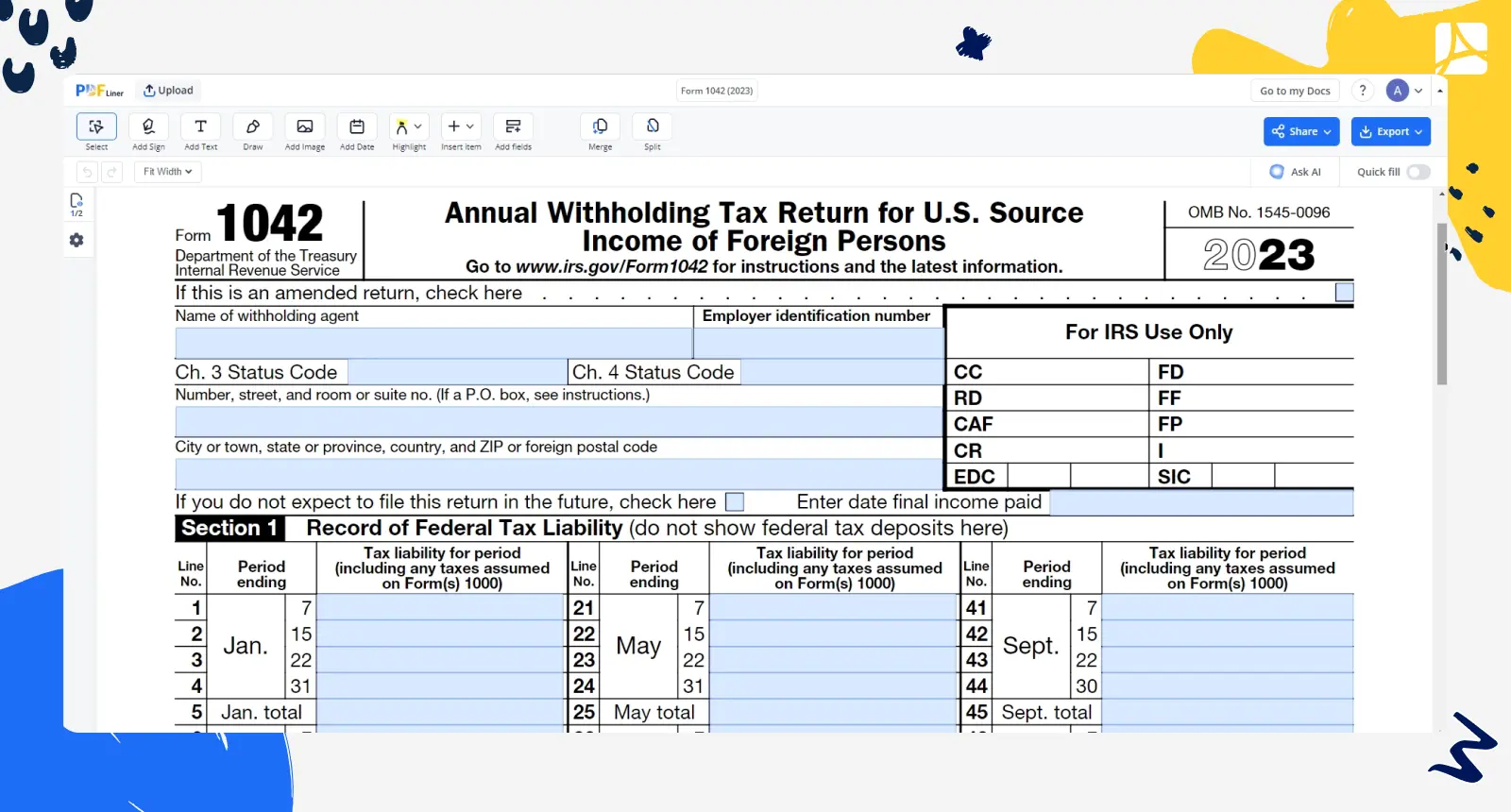
The 2025 form has two pages:
- Heading: name of the withholding agent, employer identification number (a QI, WP or WT enters its QI-EIN, WP-EIN or WT-EIN), address, and both a chapter 3 and a chapter 4 status code from the list on Form 1042-S. Both codes are required whatever type of payment you made.
- Section 1, Record of Federal Tax Liability (lines 1-60): the tax liability for each quarter-monthly period (four per month) and the monthly totals. Enter the liability, not your deposits, and no negative amounts. The monthly totals must match the liability on lines 64b, 64c and 64d.
- Lines 61 and 62: the number of Forms 1042-S filed on paper and electronically, and the total gross amounts reported on all Forms 1042-S and Forms 1000.
- Third Party Designee, Sign Here and Paid Preparer Use Only (page 1).
- Line 63 and lines 64-71 (page 2): total tax reported as withheld or paid, then the computation of tax due or overpayment. An overpayment can be claimed as a refund or as a credit on the 2026 Form 1042 (restrictions apply); lines 71b-71d take direct deposit details.
- Section 2, Reconciliation of Payments of U.S. Source FDAP Income (lines 1-6): complete it even if you made no payments subject to chapter 4 withholding.
- Section 3: check the box if you made any payments under a potential section 871(m) transaction. Section 4: if a QI (its home office or any branch) was a qualified derivatives dealer (QDD) during the tax year, check the box, enter the QI's regular EIN, if any (not its QI-EIN), and attach Schedule(s) Q (Form 1042) for each QDD, even if the QDD has zero tax liability.
Round off cents to whole dollars: drop amounts under 50 cents and raise 50 to 99 cents to the next dollar. When you add several amounts for one line, include the cents and round only the total.
How and when to file
- Due date. Form 1042 is an annual return for the preceding calendar year, due March 15 of the following year; if that day is a Saturday, Sunday or legal holiday, the next business day. For the 2025 form that was Monday, March 16, 2026, because March 15, 2026 was a Sunday.
- E-filing. Electronic filing through the Modernized e-File (MeF) platform is required for a withholding agent that is a financial institution, for a withholding agent required to file 10 or more returns of any type (information returns such as Forms W-2, 1099 and 1042-S, and income tax, employment tax and excise tax returns) during the calendar year in which the Form 1042 is due, and for a partnership with more than 100 partners. Under that 10-return rule (Regulations section 301.6011-15), a withholding agent that is an individual, estate or trust is not required to e-file. The administrative exemptions covered Forms 1042 that were due in 2024 and 2025. If you are required to e-file and file on paper instead, you are treated as not having filed the return. The IRS waiver page words it more broadly ("withholding agents ... must e-file the 2025 form"), while the instructions still give a mailing address for paper returns: before you mail a paper Form 1042, check the three criteria above and the IRS e-file waiver page (see resources).
- Hardship waiver. The IRS may waive the e-filing requirement if the withholding agent can show it would result in a hardship. The IRS's Form 1042 waiver page says that for the 2025 form the written request, signed under penalties of perjury by an officer authorized to sign the return, had to be submitted by March 15, or 45 days before the return due date if filing under an extension. March 15, 2026 was a Sunday, so under the weekend rule (Internal Revenue Code section 7503) a request submitted on Monday, March 16, 2026 was considered timely. The IRS page adds that for tax year 2025 letters will not be issued.
- Religious exemption. A filer for whom using the technology required to e-file conflicts with their religious beliefs is automatically exempt from e-filing Form 1042 and files on paper; advance approval is not required. IRS Topic no. 803 says to write "Religious Exemption" in bold letters at the top of page 1 of the paper return.
- More time to file. Form 7004 gives an automatic extension of time to file, generally 6 months, if you complete it properly, make a proper estimate of the tax, file it by the due date of the return and pay any tax that is due. It does not extend the time to pay the tax.
- Amending. File an amended Form 1042 on the form for the year you are amending, check the "Amended Return" box, complete the entire form, sign it and attach a statement explaining why. Don't amend Form 1042 to recover tax overwithheld in the prior year. Earlier forms are under "Show form versions".
Deposits and penalties
Deposit the withheld tax through the Electronic Federal Tax Payment System (EFTPS) or IRS Direct Pay; don't mail deposits to the IRS. If you fail to use EFTPS or IRS Direct Pay, you may be subject to a 10% penalty. For an EFTPS deposit to be on time, you must generally submit it by 8 p.m. Eastern time the day before the date it is due (the instructions describe same-day options). How often you deposit depends on the amount:
- $2,000 or more. If undeposited taxes total $2,000 or more at the end of any quarter-monthly period (the 7th, 15th, 22nd and last day of the month), deposit them within 3 business days after the end of that period.
- At least $200 but less than $2,000. If that is the total at the end of any month, deposit within 15 days after the end of the month. Special carry-over rules apply after a deposit of $2,000 or more in the same month; see the instructions.
- Less than $200. If that is the total at the end of the calendar year, you may pay it with Form 1042 or deposit it by March 15 of the following year.
Penalties, unless you show reasonable cause and not willful neglect:
- Late filing. Generally 5% of the unpaid tax for each month or part of a month the return is late, up to 25% of the unpaid tax.
- Late payment. Usually one-half of 1% of the unpaid tax for each month or part of a month the tax is unpaid, up to 25% of the unpaid tax.
If both penalties apply for the same month, the late-filing penalty is reduced by the late-payment penalty for that month.
Interest is charged on tax not paid by the due date, even if you have an extension of time to file.
Who signs Form 1042
The withholding agent or intermediary may designate a partner, a member, an owner, a corporate officer authorized to sign, or a fiduciary to sign Form 1042, stating the capacity in which they act. A paid preparer completes and signs the Paid Preparer Use Only section; it stays blank when one of the persons above prepares the form.
An e-filed Form 1042 is authenticated with Form 8453-WH, or the withholding agent signs with a PIN using Form 8879-WH when filing through an electronic return originator (ERO).
What changed on the 2025 Form 1042
Compared with the 2023 and 2024 forms, the 2025 form adds lines 71b, 71c and 71d for direct deposit of a refund (the former line 71 is now line 71a) and splits the address into separate boxes. The lines of Sections 1 to 4 are numbered as before; Section 4 has been titled "Payments by a Qualified Derivatives Dealer (QDD)" since the 2024 form.
Form 1042 resources
- Form 1042 (2025), IRS PDF
- 2025 Instructions for Form 1042, IRS PDF
- About Form 1042, IRS.gov
- Requesting a waiver from the e-filing requirement of Form 1042, IRS.gov
- Topic no. 803, Electronic filing waivers or exemptions, IRS.gov
- Publication 515, Withholding of Tax on Nonresident Aliens and Foreign Entities
- About Form 1042-S, IRS.gov
- About Form 7004, IRS.gov
- Form 1040-NR
Form Versions
2019
Tax Form 1042 for 2019
2020
Tax Form 1042 for 2020
2021
Tax Form 1042 for 2021
2023
Tax Form 1042 for 2023
2024
Tax Form 1042 for 2024
Form 1042: frequently asked questions
-
Who files Form 1042: the payer or the foreign person?
The payer. Form 1042 is filed by the withholding agent or intermediary that pays or handles U.S. source income of foreign persons. A foreign person does not file it merely because they received such income. Wages paid to a nonresident alien employee are a separate case: the employer reports the tax withheld on Form 941 (a household employer, on Schedule H (Form 1040)).
-
What is the difference between Form 1042 and Form 1042-S?
Form 1042 is the withholding agent's annual return: it reports the withholding that must be paid over to the IRS. Form 1042-S reports the income and withholding to each payee. If you are required to file Forms 1042-S, you must also file Form 1042, even if no tax was withheld.
-
When is Form 1042 due, and can I get more time?
March 15 of the year after the calendar year of the payments, or the next business day if March 15 is a Saturday, Sunday or legal holiday: for the 2025 form, Monday, March 16, 2026. Form 7004, properly completed and filed by the due date of the return with a proper estimate of the tax and payment of any tax due, gives an automatic extension of time to file, generally 6 months, but not more time to pay; interest is charged on tax not paid by the due date.
-
Can I file Form 1042 on paper?
Check before you do. E-filing is required for financial institutions, for withholding agents required to file 10 or more returns of any type during the calendar year in which the return is due, and for partnerships with more than 100 partners; under that 10-return rule (Regulations section 301.6011-15) an individual, estate or trust is not required to e-file. The exemptions that allowed paper covered returns due in 2024 and 2025. If you are required to e-file, a paper return is treated as not filed unless the IRS waives the requirement for hardship or the automatic religious exemption applies (IRS Topic no. 803); under the IRS's Form 1042 waiver page the request for the 2025 form had to be submitted by March 15, or 45 days before an extended due date, and because March 15, 2026 was a Sunday a request submitted on Monday, March 16, 2026 was considered timely (section 7503). The IRS waiver page says more broadly that withholding agents, U.S. and foreign, must e-file the 2025 form, so read it before you mail a paper return.
-
Who signs Form 1042?
A person the withholding agent or intermediary designates: a partner, a member, an owner, a corporate officer authorized to sign, or a fiduciary, stating the capacity in which they act. A paid preparer signs the preparer section. An e-filed return is authenticated with Form 8453-WH or signed with a PIN under Form 8879-WH (through an electronic return originator).
Related Content - Form 1042 (2025)
-
![]() 1040 FormHow to fill out Form 1040 (2025) Form 1040 is the standard tax form individuals...
1040 FormHow to fill out Form 1040 (2025) Form 1040 is the standard tax form individuals... -
![]() Form 1040-NR (2025)What is Form 1040-NR? Form 1040-NR, U.S. Nonresident Alien Income Tax Return, is the IRS...
Form 1040-NR (2025)What is Form 1040-NR? Form 1040-NR, U.S. Nonresident Alien Income Tax Return, is the IRS... -
![]() Schedule C (Form 1040) 2025When To Use Fillable Schedule C 2025 Schedule C is attached to Form 1040 (or...
Schedule C (Form 1040) 2025When To Use Fillable Schedule C 2025 Schedule C is attached to Form 1040 (or... -
![]() Form 1040-NR-EZForm 1040-NR-EZ was the U.S. Income Tax Return for Certain Nonresident Aliens With No Dependents....
Form 1040-NR-EZForm 1040-NR-EZ was the U.S. Income Tax Return for Certain Nonresident Aliens With No Dependents.... -
![]() Schedule 1 (Form 1040) 2025What is Schedule 1 (Form 1040)? Schedule 1 (Form 1040), Additional Income and Adjustments to...
Schedule 1 (Form 1040) 2025What is Schedule 1 (Form 1040)? Schedule 1 (Form 1040), Additional Income and Adjustments to...






Fillable online Form 1042 (2025)