-
Templates
1099 FormsAccurately report 1099 information returns and ensure IRS filing with easeExplore all templatesW-9 W-8 FormsEasily manage and share taxpayer details to streamline payments and meet IRS requirements with confidenceExplore all templatesOther Tax FormsFillable tax forms simplify and speed up your tax filing process and aid with recordkeeping.Explore all templatesReal EstateReal estate templates for all cases, from sale to rentals, save you a lot of time and effort.Explore all templatesLogisticsSimplify your trucking and logistics paperwork with our ready-to-use transportation and freight templates.Explore all templatesMedicalMedical forms help you keep patient documentation organized and secure.Explore all templatesBill of SaleBill of Sale templates streamline the transfer of ownership with clarity and protection.Explore all templatesContractsVarious contract templates ensure efficient and clear legal transactions.Explore all templatesEducationEducational forms and templates enhance the learning experience and student management.Explore all templates
-
Features
FeaturesAI-Enhanced Document Solutions for Contractor-Client Success and IRS ComplianceExplore all featuresAI Summarizer Check out the featureAI PDF summarizer makes your document workflow even faster. Ask AI to summarize PDF, assist you with tax forms, complete assignments, and more using just one tool.Sign PDF Check out the featurePDFLiner gives the opportunity to sign documents online, save them, send at once by email or print. Register now, upload your document and e-sign it onlineFill Out PDF Check out the featurePDFLiner provides different tools for filling in PDF forms. All you need is to register, upload the necessary document and start filling it out.Draw on a PDF Check out the featureDraw lines, circles, and other drawings on PDF using tools of PDFLiner online. Streamline your document editing process, speeding up your productivity
- Solutions
- Features
- Blog
- Support
- Pricing
- Log in
- Sign Up


Schedule E (Form 1040) 2025
What is Schedule E (Form 1040)?
Schedule E (Form 1040), Supplemental Income and Loss, is used to report income or loss from rental real estate, royalties, partnerships, S corporations, estates, trusts, and residual interests in REMICs. It is attached to Form 1040, 1040-SR, 1040-NR, or 1041. The form above is the 2025 revision, two pages, OMB No. 1545-0074.
Do you need Schedule E?
You need it only if you have one of the kinds of income or loss above; filing Form 1040 by itself does not require it. Some rentals and royalties go on Schedule C instead:
- Rentals with significant services. Rental real estate generally goes on Schedule E even if it is also a trade or business, but if you provided significant services to the renter, such as maid service, report it on Schedule C. Heat and light, cleaning of public areas and trash collection are not significant services.
- Equipment and vehicles. Don't use Schedule E for renting out personal property such as equipment or vehicles (personal property leased with real estate stays on Schedule E); use Schedule C if you are in that business, or see the Schedule 1 (Form 1040) instructions (lines 8l and 24b) if you are not.
- Self-employed royalties. If you are in business as a self-employed writer, inventor, artist, etc., report royalties on Schedule C.
- Single-member LLC. In most cases a single-member domestic LLC is not a separate entity for federal income tax purposes, so its owner files Schedule E (or Schedule C or F, if applicable), unless the LLC elected to be treated as a corporation.
How to fill out Schedule E (Form 1040)
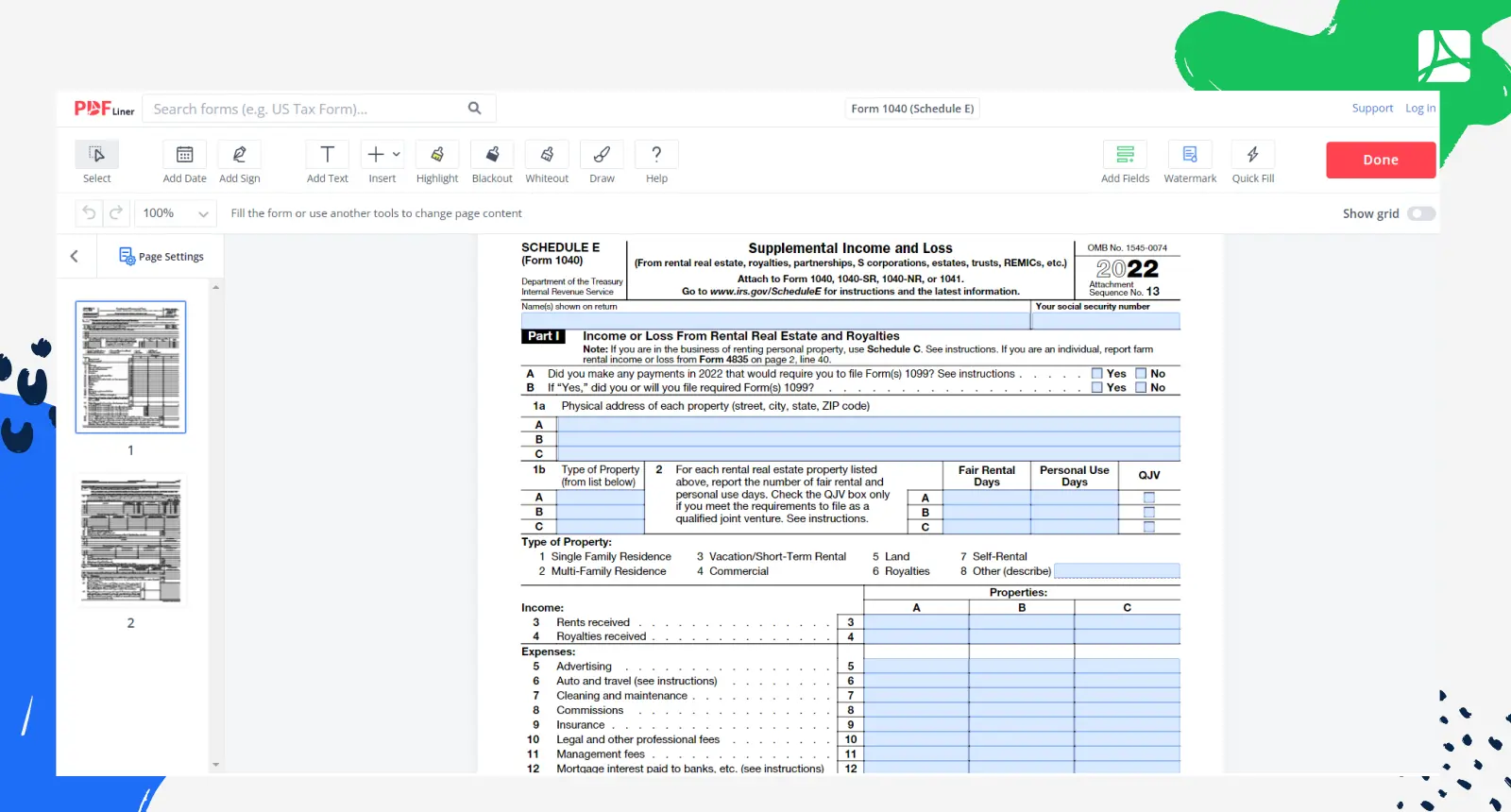
The 2025 schedule has two pages:
- Part I, rental real estate and royalties (page 1): answer questions A and B about Forms 1099, then for each property give the address (line 1a), the type of property code 1-8 (line 1b) and, for rental real estate, the fair rental days and personal use days (line 2). For a royalty property, enter code 6 and leave lines 1a and 2 blank. Report rents or royalties and expenses on lines 3-22 and the totals on lines 23a-26.
- Part II, partnerships and S corporations (lines 27-32).
- Part III, estates and trusts (lines 33-37).
- Part IV, REMIC residual interests (lines 38-39).
- Part V, summary: line 41 combines lines 26, 32, 37, 39 and 40 (net farm rental from Form 4835) and goes on Schedule 1 (Form 1040), line 5. If you only have Part I, line 26 goes there directly. An estate or trust filing Form 1041 enters the net amount on Form 1041, line 5, instead.
More than three rental or royalty properties: attach as many Schedules E as needed, but answer lines A and B and fill in lines 23a through 26 on only one of them, with the combined totals.
Rental property rules to know
- Rental and personal days. Line 2 asks for the days each property was rented at fair rental value and the days of personal use.
- Used as a home. You used a dwelling unit as a home if your personal use was more than the greater of 14 days or 10% of the days it was rented at a fair rental price. Personal use includes use by your family (unless the unit is rented to them at a fair rental price as their main home) and by anyone who pays less than a fair rental price. Don't count as personal use any day you spent working substantially full time repairing and maintaining the unit (even if family members used it for recreation that day), or days you used it as your main home before or after renting it, if you rented or tried to rent it for at least 12 consecutive months (or for a shorter period ending when you sold or exchanged it). If you used it as a home and rented it out for fewer than 15 days in 2025, don't report the rent and don't deduct rental expenses; if you rented it out for 15 days or more, you may not be able to deduct all your rental expenses (see Pub. 527).
- Split expenses. The home-use test and expense allocation use different day counts. A day of personal use is personal for the home-use test even if the unit was also rented at a fair rental price that day; for expense allocation, that day counts as rental use. The main-home-before-or-after-renting exception above does not apply to expense allocation. Allocate by personal-use days to total days of use: 7 personal-use days and 63 rental-use days means that in most cases 10% of the expenses is personal and can't be deducted on Schedule E (see Pub. 527).
- Not rented for profit. If you don't rent the property to make a profit, you must still report the rental income, on Schedule 1 (Form 1040), line 8j, but you can't deduct rental expenses (see Pub. 527).
- Spouses (QJV). Spouses who each materially participate as the only members of a jointly owned rental real estate business and file a joint return can elect qualified joint venture treatment instead of a partnership by checking the QJV box on line 2 for each property; each spouse then reports their interest as a separate property on line 1. A business owned through an LLC or other state law entity does not qualify, and mere joint ownership of property that is not a trade or business does not qualify.
- Losses may be limited. A loss in Part I, II or III may be reduced or disallowed for the year by the basis, at-risk and passive activity loss rules (Forms 6198 and 8582), and by the excess business loss limitation (Form 461).
- Mileage. The standard mileage rate for rental activities is 70 cents a mile for 2025.
Schedule E (Form 1040) resources
- Schedule E (Form 1040) 2025, IRS PDF
- 2025 Instructions for Schedule E (Form 1040), IRS PDF
- About Schedule E (Form 1040), IRS.gov
- Publication 527, Residential Rental Property, IRS.gov
- Schedule C (Form 1040)
- Schedule 1 (Form 1040)
Form Versions
2024
Fillable Form 1040 Schedule E for 2024
2023
Fillable Form 1040 Schedule E for 2023
2022
Fillable Form 1040 Schedule E for 2022
Schedule E (Form 1040): frequently asked questions
-
Where does the Schedule E total go?
Line 41 (the combined total of Parts I-V) goes on Schedule 1 (Form 1040), line 5. If only Part I applies to you, the line 26 amount goes there. Estates and trusts filing Form 1041 enter the net amount on Form 1041, line 5.
-
Do I report a vacation home I rented out for a few days?
If you used it as a home and rented it out for fewer than 15 days in 2025, don't report the rental income and don't deduct rental expenses. Otherwise, if you rent it to make a profit, report the rental days and personal use days on line 2 and split the expenses between rental and personal use.
-
Should my short-term rental go on Schedule E or Schedule C?
Generally Schedule E. If you provided significant services to the renter, such as maid service, report it on Schedule C. Heat and light, cleaning of public areas and trash collection don't count as significant services.
-
I have more than three rental properties. What do I do?
Attach as many Schedules E as you need. Answer lines A and B and fill in lines 23a through 26 on only one of them, with the combined totals for all properties.
-
Did Schedule E change for 2025?
The lines and layout are the same as on the 2023 and 2024 schedules; only the year (and a creation-date footer) changed. The 2025 instructions list tax-law changes, such as the 70 cents a mile standard mileage rate. Use the schedule for the year you are filing; earlier years are under "Show form versions".
Related Content - Schedule E (Form 1040) 2025
-
![]() 1040 FormHow to fill out Form 1040 (2025) Form 1040 is the standard tax form individuals...
1040 FormHow to fill out Form 1040 (2025) Form 1040 is the standard tax form individuals... -
![]() Form 1040-NR (2025)What is Form 1040-NR? Form 1040-NR, U.S. Nonresident Alien Income Tax Return, is the IRS...
Form 1040-NR (2025)What is Form 1040-NR? Form 1040-NR, U.S. Nonresident Alien Income Tax Return, is the IRS... -
![]() Schedule C (Form 1040) 2025When To Use Fillable Schedule C 2025 Schedule C is attached to Form 1040 (or...
Schedule C (Form 1040) 2025When To Use Fillable Schedule C 2025 Schedule C is attached to Form 1040 (or... -
![]() Form 1040-NR-EZForm 1040-NR-EZ was the U.S. Income Tax Return for Certain Nonresident Aliens With No Dependents....
Form 1040-NR-EZForm 1040-NR-EZ was the U.S. Income Tax Return for Certain Nonresident Aliens With No Dependents.... -
![]() Form 1042 (2025)What is Form 1042? Form 1042, Annual Withholding Tax Return for U.S. Source Income of...
Form 1042 (2025)What is Form 1042? Form 1042, Annual Withholding Tax Return for U.S. Source Income of...






Fillable online Schedule E (Form 1040) 2025