-
Templates
1099 FormsAccurately report 1099 information returns and ensure IRS filing with easeExplore all templatesW-9 W-8 FormsEasily manage and share taxpayer details to streamline payments and meet IRS requirements with confidenceExplore all templatesOther Tax FormsFillable tax forms simplify and speed up your tax filing process and aid with recordkeeping.Explore all templatesReal EstateReal estate templates for all cases, from sale to rentals, save you a lot of time and effort.Explore all templatesLogisticsSimplify your trucking and logistics paperwork with our ready-to-use transportation and freight templates.Explore all templatesMedicalMedical forms help you keep patient documentation organized and secure.Explore all templatesBill of SaleBill of Sale templates streamline the transfer of ownership with clarity and protection.Explore all templatesContractsVarious contract templates ensure efficient and clear legal transactions.Explore all templatesEducationEducational forms and templates enhance the learning experience and student management.Explore all templates
-
Features
FeaturesAI-Enhanced Document Solutions for Contractor-Client Success and IRS ComplianceExplore all featuresAI Summarizer Check out the featureAI PDF summarizer makes your document workflow even faster. Ask AI to summarize PDF, assist you with tax forms, complete assignments, and more using just one tool.Sign PDF Check out the featurePDFLiner gives the opportunity to sign documents online, save them, send at once by email or print. Register now, upload your document and e-sign it onlineFill Out PDF Check out the featurePDFLiner provides different tools for filling in PDF forms. All you need is to register, upload the necessary document and start filling it out.Draw on a PDF Check out the featureDraw lines, circles, and other drawings on PDF using tools of PDFLiner online. Streamline your document editing process, speeding up your productivity
- Solutions
- Features
- Blog
- Support
- Pricing
- Log in
- Sign Up


Texas Residential Lease Application
Get your Texas Residential Lease Application in 3 easy steps
-
01 Fill and edit template
![Fill Texas Residential Lease Application]()
-
02 Sign it online
![Sign Texas Residential Lease Application]()
-
03 Export or print immediately
![Export Texas Residential Lease Application]()


What Is a Texas Residential Lease Application?
A residential lease application is the form a prospective tenant fills out so a landlord can screen them before offering a lease. The template on this page is PDFLiner's own generic form for Texas rentals; it is not a Texas REALTORS form and not a government form. Texas does not prescribe a particular rental application form. A landlord using its own form must comply with Subchapter I of Chapter 92 of the Texas Property Code and other applicable laws, including fair housing and consumer-reporting requirements.
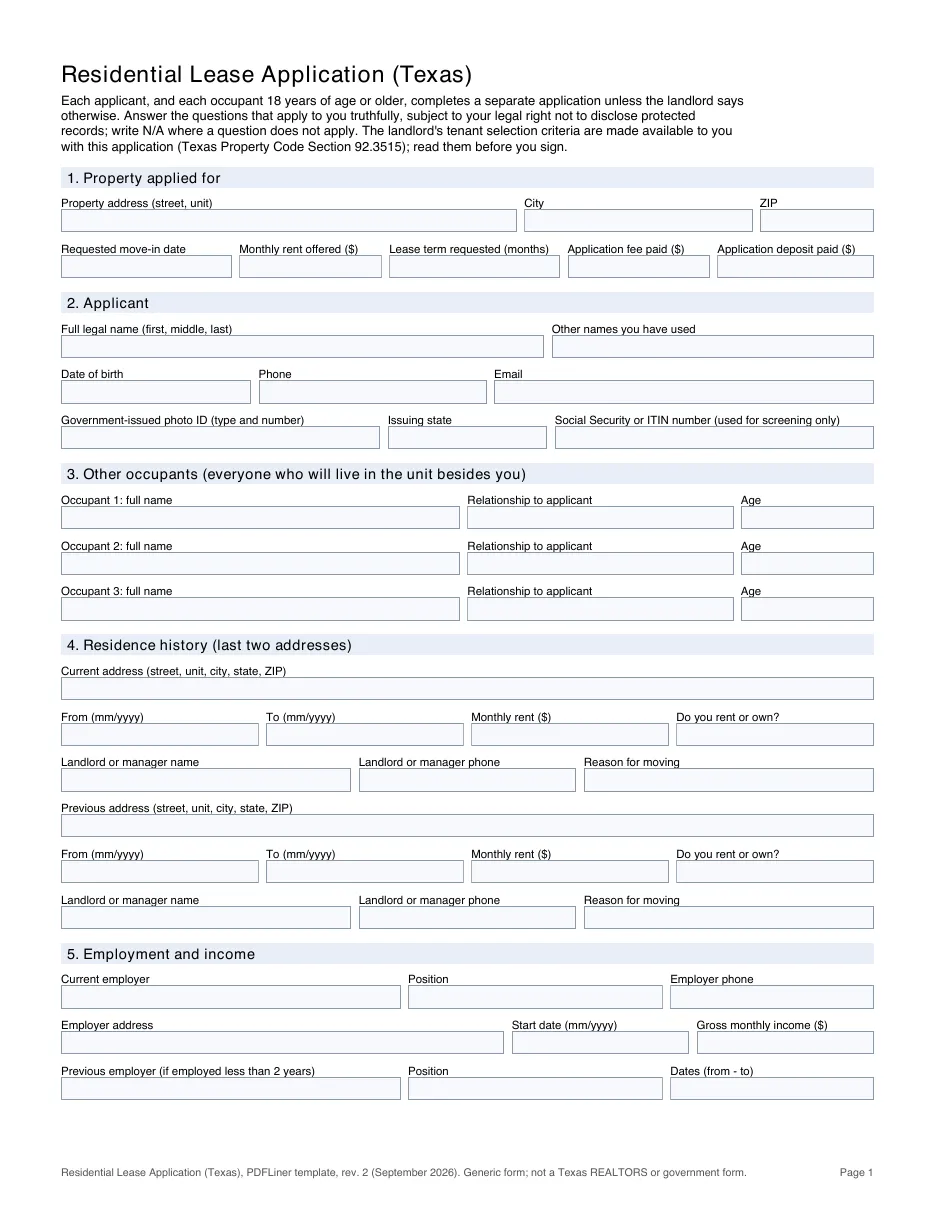
What the template covers
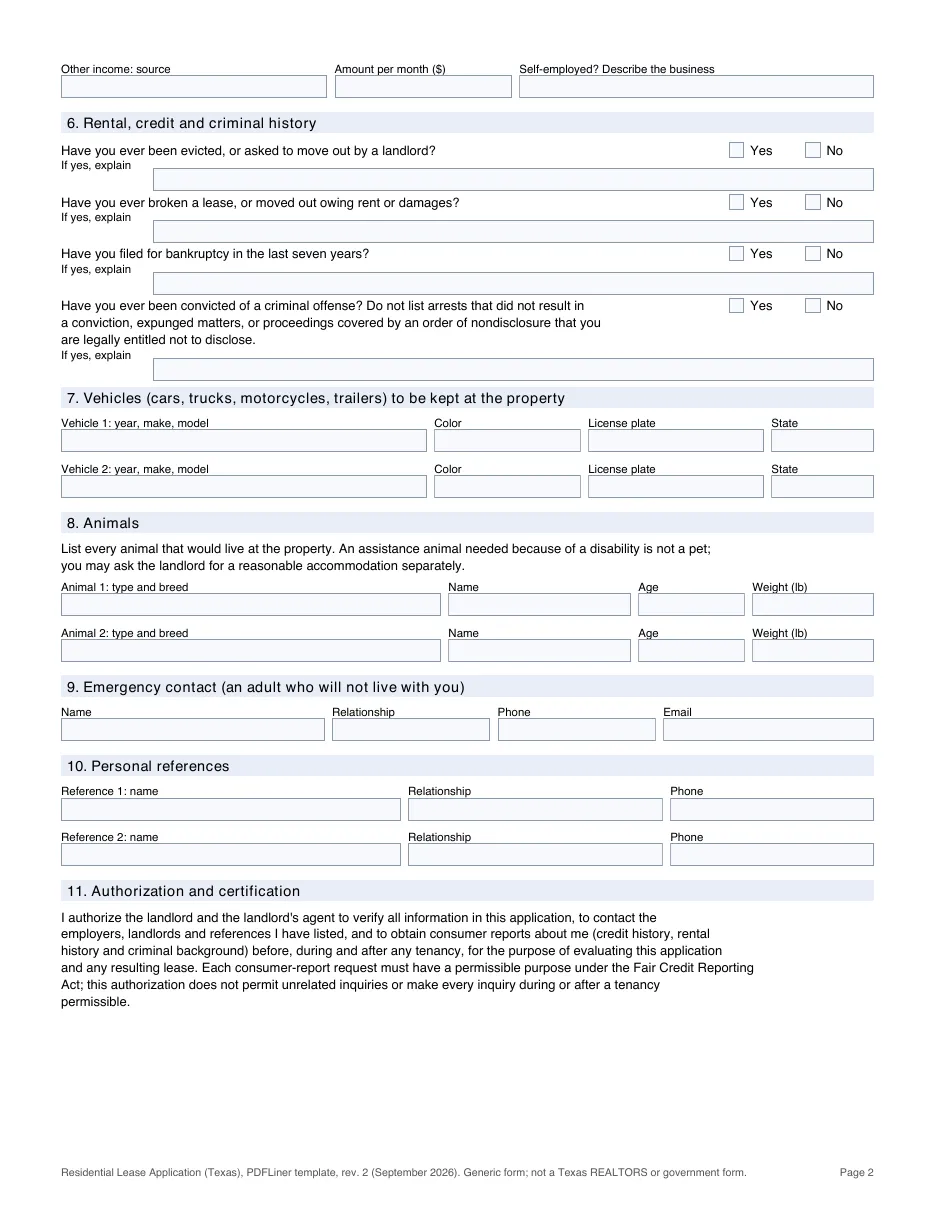
The template has three pages and thirteen sections:
- the property applied for, the requested move-in date, the rent offered, the lease term requested, and any application fee or application deposit paid;
- the applicant's details (legal name, other names used, date of birth, contact details, a government-issued photo ID, and a Social Security or ITIN number used only for screening);
- other occupants, the last two addresses with landlord contacts, and employment and income;
- four yes/no questions on rental, credit and criminal history (eviction, a broken lease, bankruptcy in the last seven years, and criminal convictions, excluding non-conviction arrests, expunged matters and proceedings covered by an order of nondisclosure that the applicant is legally entitled not to disclose);
- vehicles, animals (with a note that an assistance animal needed because of a disability is not a pet), an emergency contact and two references;
- an authorization to verify the application and obtain consumer reports, a certification that the answers are true, the tenant selection criteria acknowledgment, and an office-use block for the landlord's decision.
Why the tenant selection criteria acknowledgment matters
Under Texas Property Code Section 92.3515, when a landlord gives an applicant a rental application, the landlord must make available printed notice of the landlord's tenant selection criteria and the grounds on which the application may be denied, such as criminal history, previous rental history, current income, credit history, or inaccurate or incomplete information on the application. The applicant signs an acknowledgment that the criteria were made available; the statute lets the acknowledgment be part of the application only if the criteria notice itself is underlined or in bold print, so a landlord using this template should print its criteria notice that way; the template's section 12 carries the acknowledgment in bold. The acknowledgment text on the template is the wording the statute itself gives.
The acknowledgment protects both sides. If a landlord rejects an applicant without having made the criteria notice available, the landlord must return the application fee and any application deposit, and must mail the refund check to the applicant's address if the applicant asks. A landlord who in bad faith fails to refund a fee or deposit owed under Subchapter I is liable for $100, three times the amount wrongfully retained, and the applicant's reasonable attorney's fees, and any clause in an application that tries to waive these rules is void.
Fees, deposits and the seven-day rule
Texas law distinguishes an application fee, a non-refundable charge that offsets the landlord's screening costs, from an application deposit, which is refundable if the applicant is rejected. Texas sets no cap on the amount of an application fee for ordinary private rentals (some TDHCA-regulated affordable housing developments limit fees to the actual cost of screening and permitted processing costs). Once a completed application is submitted on the landlord's form, the applicant is deemed rejected if the landlord does not give notice of acceptance on or before the seventh day after submission (or after the landlord accepts an application deposit, when no form was furnished); if that day is a Saturday, Sunday or a state or federal holiday, the deadline moves to the end of the next day. Rejecting one co-applicant rejects all co-applicants.
Screening reports and fair housing
The authorization and certification are in section 11: the applicant authorizes the landlord to verify the answers and to obtain consumer reports (credit, rental and criminal history), and reads them together with the tenant selection criteria acknowledgment before signing the application in section 12. Each consumer-report request must have a permissible purpose under the Fair Credit Reporting Act; the authorization does not permit unrelated inquiries or make every inquiry during or after a tenancy permissible. If the landlord then takes an adverse action based on a consumer report, for example denies the application, requires a co-signer, or asks for a deposit that would not be required of another applicant, the federal Fair Credit Reporting Act requires an adverse action notice that gives the reporting agency's name, address and phone number, states that the agency did not make the decision and cannot give the specific reasons for it, and explains the applicant's right to dispute the report and to request a free copy from the agency within 60 days; if a credit score was used, further score disclosures are required. Landlords must also follow fair housing law: the Texas Fair Housing Act bars refusing to rent because of race, color, religion, sex, familial status or national origin, and separately bars discrimination because of disability, including refusing a reasonable accommodation that may be necessary; Section 301.041 exempts certain single-family houses rented by their owner and certain owner-occupied small buildings from those provisions, though discriminatory advertising stays barred and federal law may still apply. The form includes identity, occupant and animal information; these fields must not be used to discriminate unlawfully, and disability-related accommodation requests must be considered under the law applicable to the property.
How to Fill Out the Texas Residential Lease Application
Each applicant, and each occupant 18 or older, completes a separate application unless the landlord says otherwise. Answer the questions that apply to you truthfully, subject to your legal right not to disclose protected records (expunged matters and proceedings covered by an order of nondisclosure), and write N/A where a question does not apply. An explanation is required for a yes answer in section 6, but lawful nondisclosure is not an inaccurate or incomplete answer.
- When you receive the application, ask for and read the landlord's printed tenant selection criteria first. Then open the template in the PDFLiner editor and fill in section 1: the property address, your requested move-in date, the monthly rent you are offering, the lease term you want, and any application fee or deposit you are paying.
- Complete section 2 with your legal name, other names you have used, date of birth, phone, email, a government-issued photo ID and, if the landlord screens with it, your Social Security or ITIN number.
- List other occupants in section 3 and your current and previous address in section 4, with each landlord's or manager's name and phone and your reason for moving.
- Give your employer, position, start date and gross monthly income in section 5, plus any other income and a previous employer if you have been employed less than two years.
- Answer the four yes/no questions in section 6 and explain any yes answer on the line provided; you need not list non-conviction arrests, expunged matters or proceedings covered by an order of nondisclosure you are entitled not to disclose.
- Fill in vehicles (section 7), animals (section 8), an emergency contact who will not live with you (section 9) and two personal references (section 10).
- Read the authorization and certification in section 11 and the tenant selection criteria acknowledgment in section 12; ask the landlord for the printed criteria if you have not received them.
- Sign and date section 12 with the "Sign Field" tool, print your name, and download the PDF or send it to the landlord. Section 13 is for the landlord.
Landlords: keep the office-use block for the date you received the completed application and the date you notified the applicant, and keep evidence of how notice was given (a call record or the mail postmark), so you can show the seven-day rule was met.
FAQ Texas Residential Lease Application
-
Is a landlord in Texas required to use a specific application form?
No. Texas law does not prescribe a rental application form. Any form may be used, but the landlord must make the tenant selection criteria notice available and collect the signed acknowledgment described in Texas Property Code Section 92.3515, which this template includes.
-
What is the difference between an application fee and an application deposit?
An application fee is a non-refundable charge that offsets the landlord's cost of screening the applicant; an application deposit is refundable if the applicant is rejected. Texas sets no cap on the amount of an application fee for ordinary private rentals (some TDHCA-regulated affordable housing developments limit fees to the actual cost of screening and permitted processing costs). If the landlord rejects an applicant without having made the tenant selection criteria notice available, both the fee and any deposit must be returned.
-
How long does a landlord have to answer an application?
The applicant is deemed rejected if the landlord does not give notice of acceptance on or before the seventh day after the completed application is submitted on the landlord's form (or after an application deposit is accepted when no form was furnished). If that day is a Saturday, Sunday or a state or federal holiday, the deadline extends to the end of the next day.
-
Can the landlord run a credit or background check with this form?
Yes. Section 11 is the applicant's authorization to verify the answers and obtain consumer reports. Each report request must have a permissible purpose under the Fair Credit Reporting Act; the authorization does not permit unrelated inquiries or make every inquiry during or after a tenancy permissible. If the landlord takes an adverse action based on a report, such as denying the application or requiring a co-signer, the Fair Credit Reporting Act requires an adverse action notice that gives the reporting agency's name, address and phone number, states that it did not make the decision and cannot give the specific reasons, and explains the right to dispute the report and to request a free copy within 60 days. These duties apply even if the report was only part of the reason for the decision. If a credit score was used, the landlord must also provide the required score disclosures in writing or electronically. The landlord must also certify to the reporting agency that it will use the report only for housing screening.
-
Can I sign the application electronically?
Yes. Under the Texas Uniform Electronic Transactions Act and the federal E-SIGN Act, a signature cannot be denied legal effect only because it is electronic, provided the parties agreed to conduct the transaction electronically.
Related Content - Texas Residential Lease Application
-
![]() General tenancy agreement (Form 18a)What is a General Tenancy Agreement Form 18A? This agreement is an extensive eight-page residential...
General tenancy agreement (Form 18a)What is a General Tenancy Agreement Form 18A? This agreement is an extensive eight-page residential... -
![]() LEAP-ApplicationGuide to the LEAP Application Process Online The Low-income Energy Assistance Program (LEAP) in Colorado...
LEAP-ApplicationGuide to the LEAP Application Process Online The Low-income Energy Assistance Program (LEAP) in Colorado... -
![]() Georgia Small Estate Affidavit - Form GPCSF 9Understanding the Georgia Small Estate Affidavit - Form GPCSF 9 When dealing with the affairs...
Georgia Small Estate Affidavit - Form GPCSF 9Understanding the Georgia Small Estate Affidavit - Form GPCSF 9 When dealing with the affairs... -
![]() Florida Small Estate AffidavitWhat is a Florida Small Estate Affidavit Form? A small estates affidavit Florida is a...
Florida Small Estate AffidavitWhat is a Florida Small Estate Affidavit Form? A small estates affidavit Florida is a... -
![]() Hawaii Rental Application - Form RR308What Is a Hawaii Rental Application? When looking to rent property in the beautiful state...
Hawaii Rental Application - Form RR308What Is a Hawaii Rental Application? When looking to rent property in the beautiful state...






Fillable online Texas Residential Lease Application