-
Templates
1099 FormsAccurately report 1099 information returns and ensure IRS filing with easeExplore all templatesW-9 W-8 FormsEasily manage and share taxpayer details to streamline payments and meet IRS requirements with confidenceExplore all templatesOther Tax FormsFillable tax forms simplify and speed up your tax filing process and aid with recordkeeping.Explore all templatesReal EstateReal estate templates for all cases, from sale to rentals, save you a lot of time and effort.Explore all templatesLogisticsSimplify your trucking and logistics paperwork with our ready-to-use transportation and freight templates.Explore all templatesBill of SaleBill of Sale templates streamline the transfer of ownership with clarity and protection.Explore all templatesContractsVarious contract templates ensure efficient and clear legal transactions.Explore all templatesEducationEducational forms and templates enhance the learning experience and student management.Explore all templates
-
Features
FeaturesAI-Enhanced Document Solutions for Contractor-Client Success and IRS ComplianceExplore all featuresAI Summarizer Check out the featureAI PDF summarizer makes your document workflow even faster. Ask AI to summarize PDF, assist you with tax forms, complete assignments, and more using just one tool.Sign PDF Check out the featurePDFLiner gives the opportunity to sign documents online, save them, send at once by email or print. Register now, upload your document and e-sign it onlineFill Out PDF Check out the featurePDFLiner provides different tools for filling in PDF forms. All you need is to register, upload the necessary document and start filling it out.Draw on a PDF Check out the featureDraw lines, circles, and other drawings on PDF using tools of PDFLiner online. Streamline your document editing process, speeding up your productivity
- Solutions
- Features
- Blog
- Support
- Pricing
- Log in
- Sign Up


60-Day Notice to Vacate, California
This form is not available for filling on PDFLiner
What Is a 60 Day Notice To Vacate In California
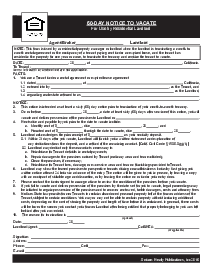
In California, a 60-day notice to Vacate is a formal declaration from a landlord to a tenant, stating that the tenancy will end on a date at least 60 days after the notice is served. This document is a critical component of the tenant-landlord relationship, ensuring both parties adhere to state regulations regarding terminating longer rental agreements. Typically, this notice is employed for tenancies that have lasted for a year or more, providing tenants ample time to find alternative accommodations and prepare for the move. It's essential to understand that this notice must comply with California's legal requirements to be valid, including clear communication of the notice period and the final date by which the tenant should vacate the premises.
When a 60-Day Notice Is Required
Under California Civil Code section 1946.1, an owner who ends a periodic (for example, month-to-month) residential tenancy generally must give written notice at least 60 days before the termination date. At least 30 days' notice is enough if any tenant or resident has lived in the dwelling for less than one year. At-fault terminations, such as for unpaid rent, follow separate notice rules with shorter periods.
Just Cause Under the Tenant Protection Act
For many tenancies, the notice period alone is not enough. Under Civil Code section 1946.2, part of the Tenant Protection Act of 2019, once a tenant has continuously and lawfully occupied the property for 12 months, the owner may not end the tenancy without just cause, and the just cause must be stated in the written notice. If an adult tenant is added before an existing tenant has lived there for 24 months, the protection applies once all tenants have lived there for at least 12 months, or at least one tenant has lived there for at least 24 months. Just cause is either at-fault (for example, failure to pay rent or a breach of a material term of the lease) or no-fault (for example, the owner or certain relatives moving in, or withdrawing the unit from the rental market, each subject to conditions in the statute). If a lease violation can be corrected, the owner must first give notice of the violation and a chance to correct it. For a no-fault termination, the notice must also tell the tenant about their right to relocation assistance or a rent waiver: unless a government agency or court has found the tenant at fault for the conditions that required the property to be vacated under a government agency or court order or a local ordinance, the owner either pays an amount equal to one month's rent within 15 calendar days of serving the notice, or waives the final month's rent in writing before it becomes due. If the owner chooses a rent waiver, the termination notice must state the amount waived and that no rent is due for the final month. Some properties are exempt from these rules, and local rent control or just-cause ordinances can add requirements.
Where to Get a Notice Form
This page does not offer a document or an editor. There is no California court (Judicial Council) form for this notice; private form publishers sell or publish notice forms. Before you serve a notice, check that the form you use states the just cause where the Tenant Protection Act applies and includes the statement about personal property left behind that Civil Code section 1946.1 requires, or ask a California attorney or your local housing agency.
Who May Serve A 60 Day Notice To Vacate In California
The ability to serve a 60-day Notice to Vacate in California is not limited to landlords alone. Property managers or landlords’ representatives also possess the authority to issue this notice, provided they act within their employment or representation scope. It's imperative for the individual serving the notice to understand the legal requirements and ensure that the notice is delivered appropriately. This ensures that the process respects the tenant's rights and complies with state procedures, allowing for a smooth transition for both parties.
Related Content - 60-Day Notice to Vacate, California
-
![]() FL-341(C) Children s Holiday Schedule AttachmentWhat Is Form FL-341(C)? Child Custody Holiday Schedule California, or an FL-341(C) form, is a...
-
![]() Form FW-001 Request to Waive Court FeesForm FW-001, Request to Waive Court Fees, is a Judicial Council of California form. The...
-
![]() Form FL-142A Practical Guide to Completing the FL-142 Form in California Filling out legal forms can...
-
![]() SUM-100 SummonsWhat is the Summons (SUM-100) The California Judicial Council Form SUM-100, commonly known as the "Summons,"...
-
![]() FL-341D Additional Provisions - Physical Custody AttachmentWhat is FL-341D? The full name of the form FL-341D is Additional Provisions, Physical Custody...